
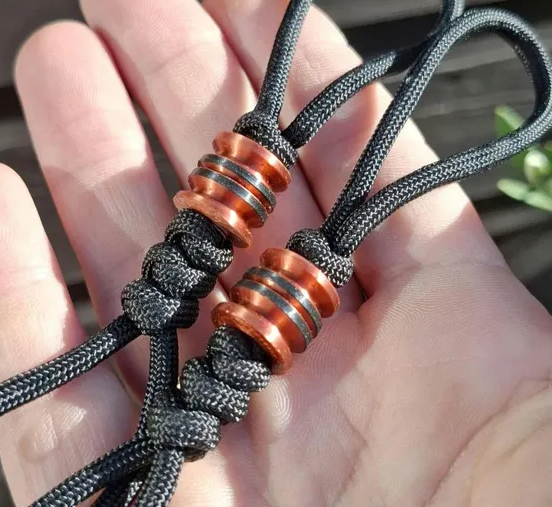

Lanyard beads transform basic paracord into personalized EDC gear. These small metal or composite stoppers serve dual purposes: they prevent cord from slipping through your grip and add visual character to knives, flashlights, and keychains. The right bead matches your cord diameter, complements your carry style, and withstands daily abuse without cracking or corroding.
More about paracord beads:
What Materials Work Best for Paracord Lanyard Beads?

Lanyard Beads for Paracord – Metal Bead Comparison on EDC Gear
Titanium, brass, and stainless steel dominate the market because they combine durability with corrosion resistance. Each material offers distinct advantages depending on your environment and aesthetic preferences.
- Titanium beads weigh almost nothing. A typical 0.5-inch titanium bead weighs around 2 grams—half the weight of brass. This matters when you’re carrying multiple tools on a belt loop or in a pocket. Titanium doesn’t rust, tarnish, or react with sweat. The downside? Cost. Expect to pay $15-30 per bead from reputable makers.
- Brass develops a patina over time. Some users love this aged look; others polish their beads weekly to maintain shine. Brass beads typically cost $8-15 and offer excellent grip texture. They’re heavier than titanium, which some prefer for the tactile feedback when handling a knife or tool.
- Stainless steel splits the difference. It resists corrosion like titanium but costs closer to brass—usually $10-18 per bead. The weight falls between the two as well. Marine environments favor stainless steel 316L grade, which handles saltwater exposure without pitting.
- Copper beads oxidize quickly, creating green patina. This isn’t a defect—it’s copper’s natural response to moisture. If you want a living finish that changes character, copper delivers. Just know it will stain light-colored cord over time.
- Polymer beads (Delrin, G10) resist all corrosion and weigh almost nothing. They lack the premium feel of metal but excel in extreme cold where metal becomes uncomfortable to touch. Prices run $5-12.
How to Match Bead Hole Size to Your Paracord Diameter
Standard 550 paracord requires a minimum 4 mm hole diameter, while micro cord needs only 2 mm. Getting this wrong means either a bead that won’t fit or one that slides around uselessly.
- 550 paracord (also called Type III) measures roughly 4 mm in diameter. Most EDC lanyard beads feature 4.5-5 mm holes. This provides enough clearance for the cord plus a stopper knot. When you tie a diamond knot or snake knot at the end, it creates a bulge that prevents the bead from sliding off.
- 275 paracord (Type II) measures about 2.5 mm. You need beads with 3-3.5 mm holes. These smaller beads work well for keychain lanyards where bulk matters.
- Micro paracord runs around 1.2 mm. Beads for micro cord typically have 1.5-2 mm holes. These tiny beads suit zipper pulls and minimalist applications.
Here’s the critical part: always check if you’re running a single or double strand. Doubling back 550 cord means you need at least a 6 mm hole. Many beginners buy beautiful beads only to discover their planned weave pattern won’t fit through.
“Test-fit your bead before committing to a complex weave. Thread it on, tie your stopper knot, and actually use it for a day. I’ve seen $40 titanium beads abandoned because the hole was 0.5 mm too small for the user’s preferred cobra weave.”
Which Bead Designs Serve Functional Purposes Beyond Decoration?

Paracord Lanyard Bead Materials – Titanium, Brass, Steel, Copper, and Polymer Comparison
Skull beads, lantern beads, and tritium-compatible beads offer specific tactical advantages. The shape and features determine whether a bead is purely aesthetic or genuinely useful.
- Skull beads with textured surfaces provide superior grip when your hands are wet or gloved. The eye sockets and teeth create natural finger grooves. This matters when you’re pulling a knife from a sheath in rain or snow.
- Lantern beads (cylindrical with vertical grooves) were originally designed for grip enhancement. The grooves channel water away and prevent slipping. They’re less aggressive-looking than skulls, which matters in professional environments.
- Tritium-compatible beads contain a small cavity that holds a tritium vial. These glow continuously for 10-25 years without batteries or charging. In complete darkness, you can locate your flashlight or knife instantly. The glow is subtle—not bright enough to compromise night vision but sufficient for finding gear in a tent or vehicle.
- Flat-sided beads prevent rolling when you set tools on a table. This seems minor until you’ve watched an expensive knife roll off a workbench because the round bead acted like a wheel.
- Beads with integrated bottle openers or hex wrench cutouts add utility. A 10 mm hex cutout in a brass bead can tighten common fasteners. Some makers incorporate pry tips, though these work better in theory than practice—the leverage is poor.
Evolution: From Decorative Fobs to Tactical Tools
Lanyard beads evolved from 19th-century sailor’s decorative knot work into modern EDC components designed for specific mechanical functions. Understanding this progression explains why certain designs persist while others vanish.
- Sailors created elaborate rope work during long voyages, adding beads and knots to knife lanyards purely for aesthetics and to prevent loss overboard. These early beads were carved wood, bone, or scrimshawed ivory. They looked impressive but offered no functional advantage beyond weight.
- The military adopted lanyards for pistols and knives in the early 1900s. Beads served as quick-detach points—you could snap the cord at the bead rather than untying knots. But these were still primarily loss-prevention devices.
- In the 1990s, custom knifemakers began experimenting with machined metal beads. They discovered that specific shapes improved weapon retention during combatives. The modern skull bead emerged from this era—the eye sockets weren’t decorative; they were finger indexes for consistent grip in darkness.
- A failed experiment from this period: magnetic beads. The idea was that you could attach your knife to metal surfaces hands-free. Reality: magnets strong enough to hold a knife were strong enough to interfere with compasses and erase magnetic stripe cards. They also collected metal shavings, creating an abrasive paste that damaged finishes.
Today’s beads incorporate lessons from 30 years of user feedback. Hole sizes are standardized. Materials are chosen for specific environments. The decorative element remains, but it’s secondary to function.
Common Mistakes That Ruin Your Lanyard Setup
Using beads with sharp internal edges will see through the paracord within weeks
This single error destroys more lanyards than all other mistakes combined.
- The cost: Rough, unfinished holes create metal burrs that continuously abrade the nylon sheath of the paracord when you pull on the lanyard. This causes the cord to fray and fail prematurely, often costing you a lost tool.
- The fix: Run your finger inside the bead hole. You should feel smooth, rounded edges. If you detect any sharpness, either return the bead or carefully chamfer the edges yourself with fine sandpaper wrapped around a drill bit.
Mixing incompatible metals creates galvanic corrosion that freezes your bead in place
This happens when you combine a stainless steel bead with a brass snap shackle or titanium bead with copper wire accents.
- The cost: Dissimilar metals in contact with moisture (sweat, rain) create an electrochemical reaction, causing the more reactive metal to corrode. The corrosion products expand, locking the components together. After a few months, your bead won’t slide, and your intricate weaving work is ruined.
- The solution: Stick to one metal type per project, or ensure different metals are separated by cord sections to prevent direct contact.
Overtightening stopper knots crushes paracord’s inner strands, creating a weak point.
The knot should secure the bead, not strangle the cord.
- The cost: When a stopper knot is pulled extremely tight (often with pliers), it compresses the inner seven strands of the paracord. This stresses the nylon fibers, dropping the cord’s breaking strength from 550 pounds to perhaps 300 pounds at that exact point. Your lanyard fails under moderate load.
- The solution: Tighten the knot firmly by hand, but avoid “reefing” on it. The goal is to secure the bead, not to maximize compression.
Material Comparison: Choosing Your Bead Based on Environment
| Material | Weight (0.5″ bead) | Corrosion Resistance | Typical Cost | Best Use Case | Maintenance |
| Titanium | 2g | Excellent (all environments) | $15-30 | Ultralight EDC, marine use | None required |
| Brass | 4.5g | Good (develops patina) | $8-15 | General EDC, aesthetic aging | Polish monthly or embrace patina |
| Stainless 316L | 3.5g | Excellent (marine-grade) | $10-18 | Saltwater, high-humidity | Occasional wipe-down |
| Copper | 4g | Poor (oxidizes rapidly) | $6-12 | Indoor use, patina lovers | Accept green patina or polish weekly |
| Delrin/G10 | 0.8g | Perfect (inert polymer) | $5-12 | Extreme cold, electrical work | None required |
Best Knots for Securing Lanyard Beads on Paracord
The diamond knot and snake knot provide the best combination of bulk and security for stopping beads.
- The diamond knot forms a compact, four-sided stopper. It creates a knot roughly 1.5 times the diameter of your paracord (e.g., a 6 mm stopper for 550 cord), which is perfect for preventing beads with 5 mm holes from sliding off.
- The snake knot (also called Portuguese sinnet) creates a longer, textured stopper. It’s built up from a series of half-hitches, working well when you want the stopper itself to serve as a grip extension.
- For micro cord applications, the simple overhand knot often suffices (tied two or three times).
“Melt the cut end of your paracord before tying the stopper knot, but don’t create a huge blob. You want just enough melt to prevent fraying—about 1 mm of fused nylon. A giant melted ball will prevent the knot from tightening properly and looks amateurish.”
Alternative Perspective: The Case Against Metal Beads
Some experienced users argue that metal beads compromise stealth and add unnecessary weight.
- Noise: Metal beads click against knife handles and other gear, which compromises stealth for hunters or photographers in quiet environments. Polymer beads are silent.
- Weight: For ultralight backpackers, the added grams from metal beads are considered purely decorative weight.
- Snagging: Protruding beads can catch on seatbelts, backpack straps, and clothing in confined spaces.
The right choice depends on your specific context.
How to Integrate Beads Into Different Weave Patterns

Lanyard Bead Hole Sizes for Different Paracord Diameters – Sizing Guide
- Terminal stoppers: The bead is placed at the very end of the cord, secured by a stopper knot. This is the simplest method.
- Mid-weave integration: You pause the weave, thread the bead onto both working strands, then resume weaving. This works well with cobra and snake weave patterns.
- Sliding adjusters: Two beads are used to create a loop that can be enlarged or reduced for quick length adjustment (requires at least 6 mm holes for doubled cord).
Maintenance and Longevity: Making Your Beads Last
- Titanium: Requires essentially zero maintenance.
- Brass: Use a brass polish cloth monthly to maintain shine, or do nothing to encourage a protective patina.
- Stainless steel: Wipe with a silicone cloth after saltwater exposure to prevent staining.
- Copper: Patina can be removed with a vinegar and salt soak, or you can allow the green color to develop naturally.
- Polymer beads: Need only soap and water.
The paracord itself typically requires replacement every 2-3 years for critical applications due to UV exposure and abrasion, but the quality metal or polymer beads can be reused indefinitely.