
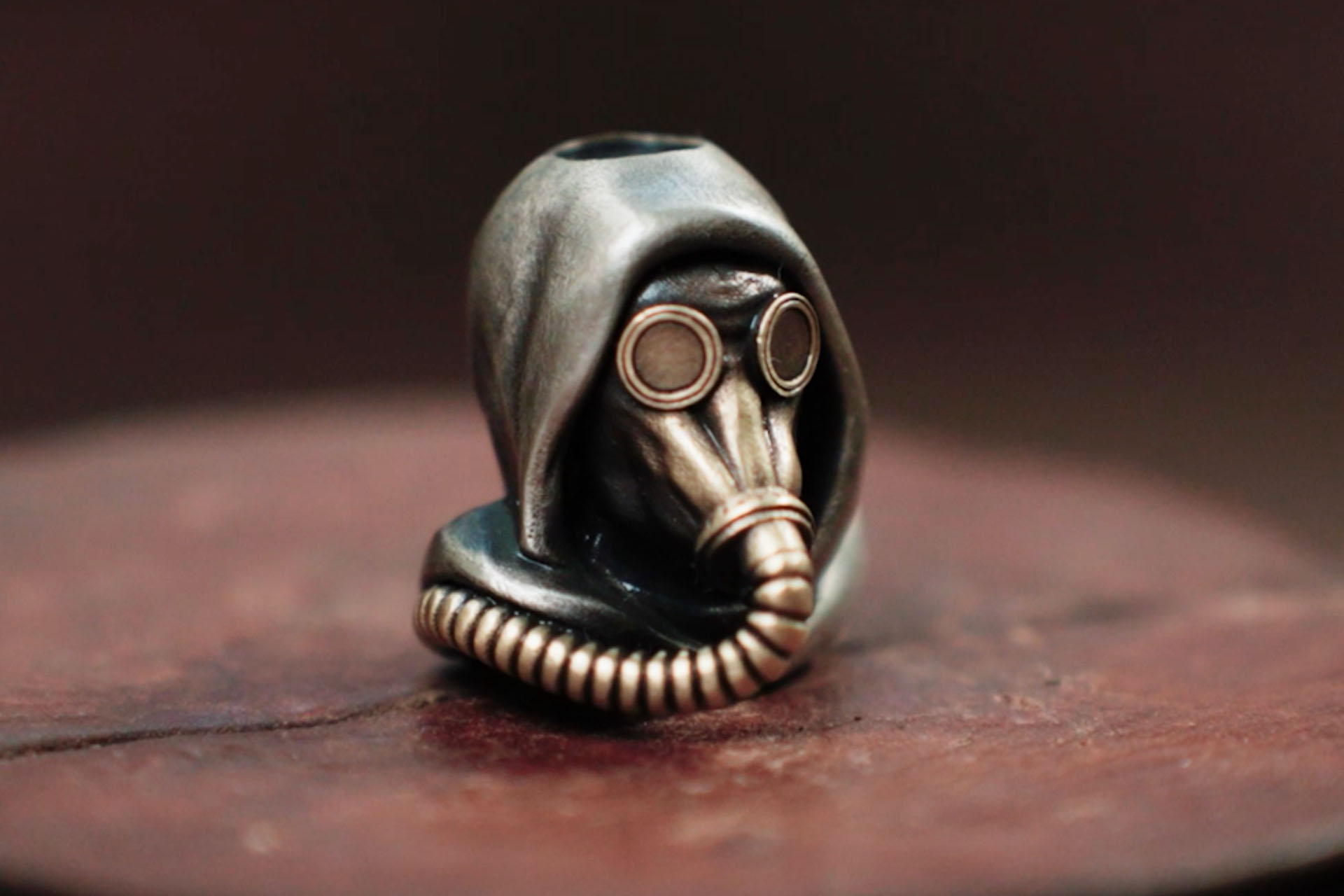

Paracord beads add weight for easier deployment while providing a tactile grip point, and they serve as decorative accents that personalize gear. These thumb-sized sleeves turn bare cordage into functional, identifiable accessories—whether you’re dressing up a knife lanyard, building a survival bracelet, or creating a quick-draw zipper pull.
This guide breaks down materials, sizing, project matching, and care so you can pick paracord beads that actually work for your build instead of rattling loose or shredding cord.
More about paracord beads:
Types and Materials:
- Titanium Paracord Beads: Essential Guide to Their Benefits, Applications, and Selection Tips
- Aluminum Paracord Beads: Your Complete Buying & Usage Guide
- Brass Paracord Beads: Complete Guide to Types, Uses & Assembly
- What Are Polymer Paracord Beads?
- G10 Paracord Beads: The Lightweight Alternative to Metal Hardware
- Stainless Steel Paracord Beads: What You Need to Know Before You Buy
- Timascus Paracord Beads: What Makes Them Worth the Premium?
- Damascus Steel Paracord Beads: What Makes Them Worth the Premium?
- Acrylic Paracord Beads: A Practical Guide to Choosing and Using Them
- Zirconium Paracord Beads: What Makes Them Worth the Premium?
Design and Functionality:
- Skull Paracord Beads: Your Complete Guide to Choosing and Using Them
- Lanyard Beads for Paracord: A Complete Guide to Choosing and Using Them
- Tactical Paracord Beads: The Functional Core of Your EDC System
- Symbolism and History of Beads for Tinsel: From Skulls to Runes in EDC Culture
Technical and Application:
- CNC Machined Paracord Beads: Precision Engineering for EDC Applications
- How to Install Paracord Beads: A Complete Step-by-Step Guide
- Complete Knot Diagrams: How to Properly Secure a Bead on Paracord
- How to Patinate Brass Beads: A Workshop Guide for Craftspeople
- Practical Guide: How to Polish Titanium Beads
Why Bore Size Matters More Than You Think
550 paracord measures approximately 4 mm in diameter, so a bead’s internal diameter determines whether one or two strands will pass smoothly without fraying.
Here’s what happens in real builds. A 5 mm opening handles one strand of 550 cord cleanly—snug, minimal play, clean profile. A 6 mm opening is the safest choice for two-strand patterns or thicker knots, providing easier assembly across different cord brands. But grab the wrong size and you’ll spend fifteen minutes forcing cord through with a hot awl, destroying both the nylon and your patience.
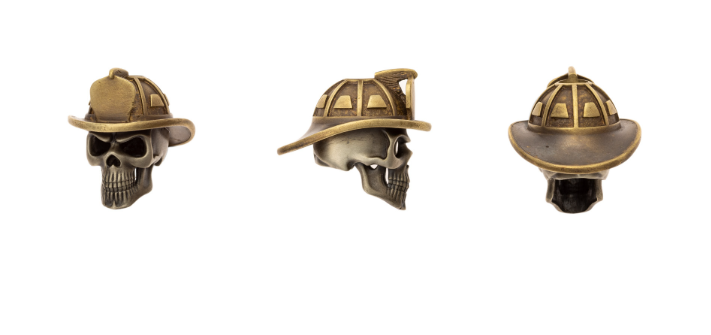
Firefighter Skull Helmet – Solid Brass Paracord Beads
Standard jewelry beads clock in at 3-4 mm—perfect for micro cord, useless for 550 unless you gut the core. Paracord beads are standardized on 5-6 mm bores to match real-world cord diameter and handle two-strand builds.
The tolerance trap: Different brands weave 550 cord slightly differently. One manufacturer’s “550” might measure 3.8 mm compressed, another hits 4.2 mm. The internal diameter should exceed cord diameter by 1 mm to account for wet-swelling nylon. That extra millimeter prevents jamming when your lanyard gets soaked in rain.
Threading Tricks That Actually Work
You don’t need specialized tools to thread stubborn paracord beads. Here’s how to do it properly:
Cut the cord end at a sharp angle with clean scissors, then melt it lightly with a lighter, holding 2 cm above the flame. Roll between your fingers while still warm—you’ve just created a tapered needle. For doubled strands, gut the last half-inch of both legs to slim them down temporarily, thread the thinned ends through the opening, pull everything through, and seat your stopper knot against the entrance.
Chamfering the bead’s inlet—even a 0.3 mm break—makes 5 mm openings feel a size larger when threading fused tips.
Material Breakdown: Brass, Titanium, Steel, and Beyond
Each metal brings specific trade-offs between weight, durability, corrosion resistance, and cost when selecting paracord beads.
- Brass hits the sweet spot for most builders. It machines cleanly, develops a warm patina over months of handling, and costs far less than exotic alloys. Weight sits around 8-15 grams depending on design complexity—enough heft to make a folder snap free from a pocket clip without dragging your keys down. The oxidation that develops isn’t weakness; it’s character. On copper and bronze variants, buffing the interior with a cotton swab and compound reduces friction and protects the nylon sheath.
- Titanium delivers aerospace strength at featherweight—typically 3-6 grams for a standard bead. Grade 5 titanium resists saltwater, sweat, and battery acid without tarnishing. Anodizing lets makers create vibrant blues, purples, and golds through controlled voltage oxidation rather than dyes. The trade-off? Cost jumps three to five times over brass, and the interior can develop micro-burrs during drilling that abrade paracord unless hand-finished.
- Stainless steel occupies middle ground: stronger than brass, heavier than titanium, and priced accordingly. Medical-grade 316L handles daily EDC abuse without tarnish. Weight reaches 12-20 grams, which stabilizes larger blades but feels excessive on slim gentleman’s folders.
- Plastic and resin options work when metal detectors or weight become issues. Modern photopolymer 3D-printed beads achieve detail impossible in cast metal—intricate dragons, anatomical skulls, geometric tessellations. They weigh 1-3 grams and cost a fraction of machined metal. The catch: UV exposure eventually yellows clear resins, and sharp impacts can crack thin features. Glow-in-the-dark beads absorb light during the day and emit a gentle glow in low-light conditions, adding functional visibility.
From Military Toggle to Micro-Sculpture: Evolution of Lanyard Hardware
Early beads were bush-carved toggles—antler nubs, bone buttons, or whittled hardwood pegs—used by trappers, sailors, and airborne infantry who needed secure stop-knots that wouldn’t jam under frost-stiff gloves.
Those primitive toggles solved a specific problem: wet rope knots fuse solid when they freeze, making emergency cord unusable. A carved bone bead provides a grip point that fingers can find even through thick gloves.
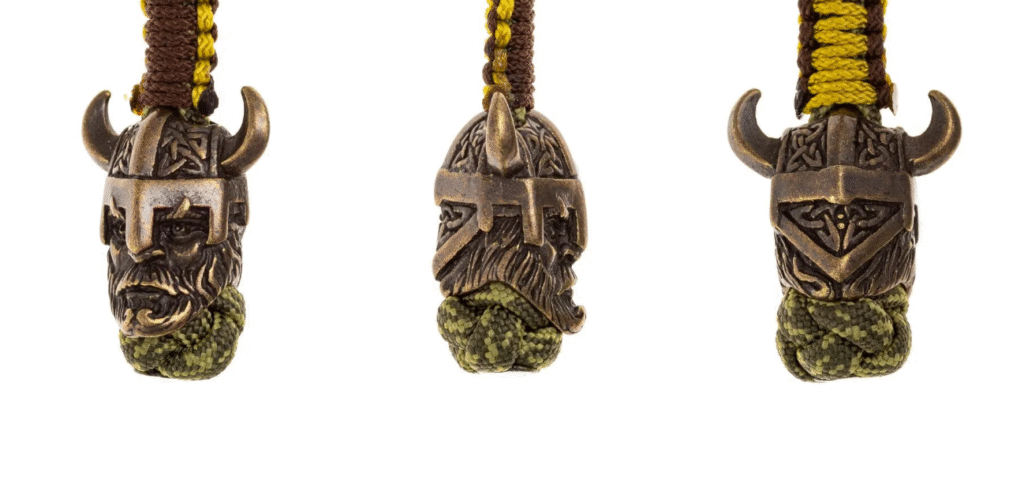
Viking Warrior with Horned Helmet – Bronze Beads for Paracord Bracelets
In the inter-war years, quartermasters experimented with stamped brass ferrules and Bakelite barrels, cheap to mass-produce yet tough enough to survive salt spray and parachute shock loads. The Bakelite experiments failed—early phenolic resins cracked under thermal cycling and became brittle in cold. Brass endured because it could be stamped quickly, held threads for set screws, and soldiers could repair damaged beads in the field with basic files.
Today’s solution evolved from knife community demands for personalization and manufacturers discovering precision machining could turn functional hardware into collectible art. CNC mills can hold tolerances tighter than 0.01 mm, enabling sculptural details that were impossible in stamped brass. Limited-run collaborations involve blacksmiths forging damascus blanks, jewelers hand-engraving runes, then bead-makers tapping the final 6 mm opening—producing trinkets that elevate even basic gear.
Matching Beads for Paracord to Projects: Knife Lanyards, Bracelets, and EDC Gear
Knife lanyards need paracord beads sized to complement blade length and handle thickness. Pocket-knife devotees use beads as everyday-carry ergonomics—a small sphere of weight at the lanyard’s end makes a folder snap free from a deep-carry clip with one flick of the pinky. Match bead mass to your blade: 12-15 gram bronze for a titanium frame-lock that needs momentum, 5-8 gram G-10 for a slip-joint where you want feel without bulk.
- Index grooves or sculpted ridges help your thumb find home in the dark without fumbling the sharp edge. For fixed blades carried on the belt, heavier 18-22 gram beads add swing weight that helps clear the sheath cleanly during a draw.
- Survival bracelets prioritize function over aesthetics. A tungsten bead turns paracord into an impromptu flail for breaking auto glass; a hollow aluminum barrel can stash potassium permanganate crystals for water purification. That extra density in tungsten (19.3 g/cm³ versus brass at 8.5 g/cm³) concentrates force into a tiny impact point—crucial when you need to shatter tempered glass in an emergency.
- Hollow paracord beads open other options: ferro rod fragments, fish hooks, tinder, medication, or a written emergency contact. Just waterproof any paper contents and test that your stopper knot doesn’t back out under stress.
- Zipper pulls and bag tags benefit from high-visibility colors and lighter weight. Anodized titanium in electric blue or safety orange makes gear identifiable at twenty feet in low light. Brightly anodized markers color-code critical gear in a rucksack so medical shears aren’t confused with tent stakes when seconds count. Keep weight under 8 grams to avoid stress on zipper fabric.
Decorative bracelets and macrame work best with matched bead sets—same material, same finish, graduated sizes. Leather-workers burnish paracord ends through hammered copper tubes for clean transitions. Space beads at calculated intervals based on wrist diameter minus cord thickness to prevent bunching.
The Engineering Trade-Off: Weight vs. Mobility
Choosing heavier bronze for stability means accepting reduced mobility in tight pockets. That 20-gram skull bead provides satisfying heft but creates bulk that snags pocket linings during draws. The compromise lives in bead shape: a compact 12 mm sphere delivers mass without length, while a 25 mm cylinder spreads the same weight over greater distance and catches more frequently.
For gloves-on operations in cold weather, deeply ribbed or hex-fluted profiles provide extra traction that smooth spheres lack. But those same aggressive textures abrade pockets during daily carry.
Three Common Mistakes That Ruin Paracord Projects
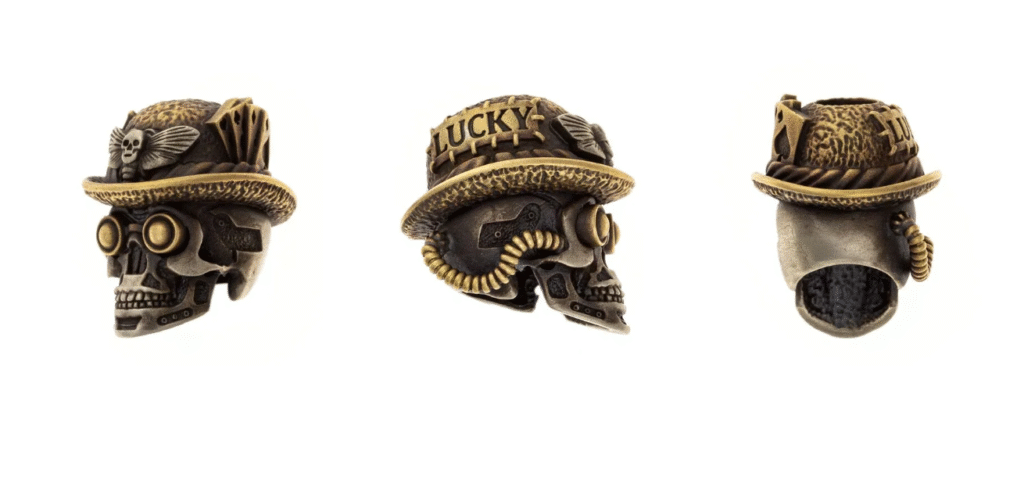
Steampunk Gambler Skull “Lucky” – Unique Beads for Paracord
Forcing Oversized Cord Through Undersized Bores
You receive your new brass bead, measure the opening at 5 mm, and assume your 550 cord will slide through easily since specifications list it at 4 mm diameter. But when you try threading two strands for a lanyard, nothing moves.
People do this because visual inspection suggests “it should fit,” and they’ve already committed to the bead design. The measurement specs don’t account for tolerance stacking—cord diameter varies by 0.3 mm between manufacturers, and dimensions can run 0.2 mm under nominal if the tap dulled during production.
Cost of the mistake: Forcing cord damages the nylon sheath. Those inner load-bearing strands that give 550 paracord its strength rating? You’re crushing and misaligning them. The bead finally seats, but now the cord at that exact point has reduced tensile strength—potentially failing at 300-400 pounds instead of 550. If this lanyard holds a knife during a climb and fails at the bead point, you’ve lost the tool and possibly created a hazard below.
For emergency survival gear, that strength reduction matters. You waste a premium bead, compromise your cord, and the fix requires cutting out the damaged section and starting over with proper 6 mm bores.
Skipping Interior Finishing on Machined Metal Beads
Fresh from the CNC mill or drill press, your new titanium bead has a perfectly-sized 6 mm opening. You thread your paracord, tie off the lanyard, and start using your knife. Three weeks later, the nylon at the bead shows fuzzing and the individual strands are starting to separate.
This happens because it looks finished. The outside is polished, anodized, and beautiful. But the interior still carries tool marks—microscopic ridges left by the drill bit or tap. Every time the bead shifts position on the cord, those ridges act like tiny files against the nylon.
Cost of the mistake: The paracord gradually fails at the bead contact point. What should last years of EDC use barely makes it through a season. If the bead sits on a knife lanyard you depend on for field work, that fuzzed section becomes the weak link in your retention system. The bead itself remains pristine while the cord deteriorates—requiring replacement and re-threading.
Professional makers run a cotton swab with polishing compound through every interior before shipping. Takes thirty seconds. Prevents months of abrasion damage. On production runs, a quick pass with a ball-end bit chamfers the entrance and breaks all sharp edges.
Mismatching Bead Weight to Carry Style
You add a stunning 22-gram damascus bead to your new titanium-frame folder with a deep-carry pocket clip. The craftsmanship is exceptional, the patina developing perfectly. But every time you sit down, the weight pulls the knife sideways in your pocket, and the clip no longer retains reliably.
Collectors pick beads for looks first, assuming “heavier equals better quality.” The bead becomes a statement piece rather than a functional component. That mass creates leverage against the clip—basic physics. The longer the lanyard and heavier the bead, the more torque gets applied to the clip retention.
Cost of the mistake: Your $400 custom knife starts riding out of your pocket during normal movement. You lose it in a car seat, movie theater, or trail without noticing. Even if it stays put, constant torque fatigues the titanium clip, causing it to lose tension over months and eventually fail to retain at all.
The fix isn’t removing the bead—it’s choosing 8-12 gram paracord beads for deep-carry setups and reserving heavy beads for belt-carried fixed blades where weight assists rather than fights retention.
Material Selection Comparison
| Material | Weight Range | Durability | Corrosion Resistance | Typical Cost | Best Use Case |
| Brass | 8-15g | Good; develops patina over time | Moderate; oxidizes with character | $3-8 | General EDC; warm aesthetic; budget builds |
| Bronze | 10-17g | Excellent; hardens with age | Good; natural verdigris protection | $5-12 | Knife lanyards; heavy-duty applications; collectors |
| Titanium (Grade 5) | 3-6g | Excellent; aerospace strength | Excellent; inert to most chemicals | $15-40 | Ultralight EDC; saltwater use; anodizing projects |
| Stainless Steel (316L) | 12-20g | Excellent; medical grade | Excellent; marine applications | $8-18 | High-weight applications; tactical gear |
| Aluminum | 2-4g | Fair; can dent under impact | Good when anodized; scratches reveal bare metal | $4-10 | Weight-critical builds; color variety; hollowing for storage |
| Resin/3D-Printed | 1-3g | Fair; UV yellowing; can crack | N/A (not applicable) | $2-6 | Complex designs; metal-detector environments; budget options |
The Case Against Ultra-Heavy Paracord Beads: When More Mass Creates Problems
Most guides celebrate bead weight as universally beneficial. Heavier always equals better deployment, better feel, better everything. But that thinking ignores real-world physics and daily carry constraints.
Bronze’s density is roughly double titanium’s, so the same bead geometry will make your lanyard feel heavier, hang straighter, and find your fingers faster. Extra mass helps pocket extraction and gloved handling, but it also adds swing, pocket print, and can scuff soft handle finishes sooner.
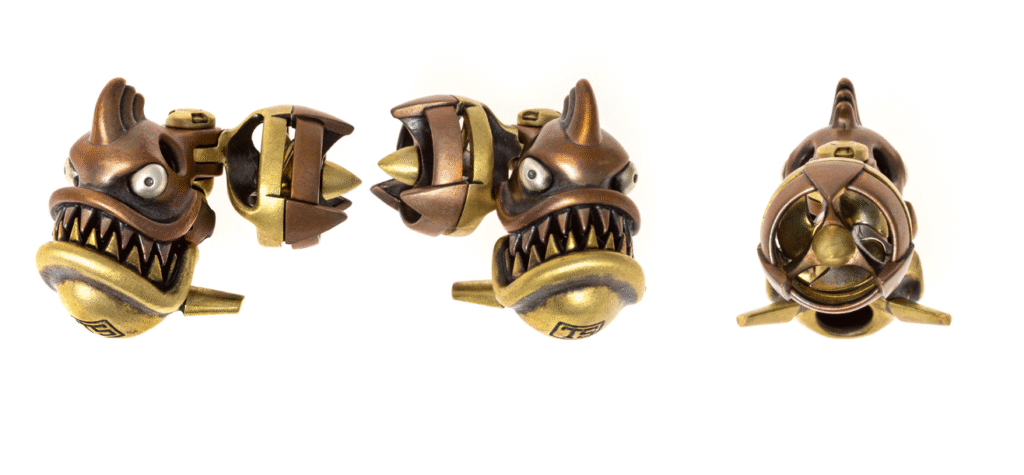
Mechanical Steampunk Piranha – Creative Beads for Paracord
The strongest argument against heavy beads comes from actual pocket carry data. Beads over 18 grams create measurable clip fatigue on titanium frame-locks within six months of daily carry. That torque—leverage multiplied by distance—stresses the clip mounting point every time you sit, bend, or shift position. Steel clips handle it better, but even they show reduced retention after a year with 25+ gram beads.
For most users carrying folders in business casual environments, the 8-12 gram range delivers optimal balance: enough mass for reliable deployment without printing through slacks or fatiguing clips. Reserve ultra-heavy paracord beads (20+ grams) for belt-carried fixed blades where weight assists draw rather than fights retention, or for survival bracelets where breaking glass requires concentrated mass.
The exception proves the rule: competition shooters and tactical trainers often prefer 15-18 gram beads because their gear sees constant manipulation during drills, and heavier beads provide positive tactile confirmation during high-stress reloads. But they also replace clips quarterly as part of scheduled maintenance—a luxury most EDC users don’t need or want.
The Subtlety of Interior Finish
Most builders focus on external aesthetics—the skull detail, the Damascus pattern, the anodizing color. But the internal surface determines whether your paracord lasts six months or six years.
Think of it like engine cylinder honing. A rough interior creates friction, generates heat through constant motion, and accelerates wear. A mirror-polished surface lets the cord slide freely during dynamic loads—when you’re yanking a knife from a sheath or pulling open a zipper on a cold morning.
Makers finish paracord beads by running a final hand ream, passing polishing compound through, and testing with real paracord to ensure the interior won’t fray under field use. That attention to unseen details separates production beads from craftsman-made pieces. You can’t see the difference visually, but your fingers feel it when threading, and your cord shows it after months of use.
Care and Maintenance: Making Beads Last
Brass and bronze develop patina naturally through skin oils and environmental exposure. Some users accelerate this with vinegar or liver of sulfur treatments for antique looks. To preserve bright finish, wipe beads weekly with a dry microfiber cloth and store away from moisture.
- Titanium requires almost no maintenance. The anodized layer is actually oxidized titanium—it won’t flake or peel like paint. Scratches reveal more titanium underneath. Avoid abrasive cleaners that can dull the finish.
- Stainless steel stays maintenance-free in daily use. For salt exposure, rinse with fresh water and dry thoroughly to prevent spotting.
- Plastic and resin beads deteriorate under UV exposure. Store them out of direct sunlight between uses. Clean with mild soap and water—alcohol or acetone can craze the surface.
The paracord matters more than the bead. Inspect cord at bead contact points every few months: look for fuzzing along the sheath, check for discoloration indicating friction heat, examine for strand separation at stress points, and test flex points for brittleness. If you spot damage, cut out that section and re-thread rather than trusting the compromised cord.
“Size your stopper knot to the opening rather than forcing a smaller diameter. A properly sized diamond knot seated inside a 6 mm bead won’t rattle and distributes load across the entire cord cross-section instead of creating a stress point.”
Finding Quality Beads for Paracord Bracelets Without Breaking the Bank
Budget beads from general craft stores typically have 3-4 mm holes—fine for jewelry, wrong for 550 paracord. Standard jewelry beads rarely exceed 4 mm holes, making them unsuitable for anything beyond single strands of gutted paracord.
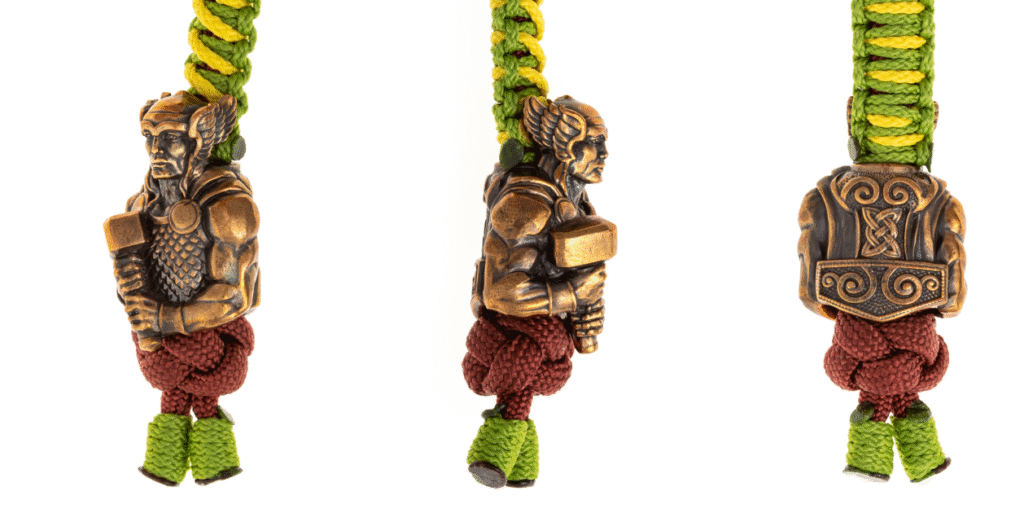
Thor God of Thunder with Hammer – Viking Beads for Paracord Bracelets
Paracord-specific suppliers stock beads with proper 5-6 mm openings and materials chosen for cordage applications. Look for makers who list dimensions in specifications, show interior photos, and mention chamfering or deburring in their process descriptions. Reputable manufacturers like TEC Accessories offer precision-machined paracord beads in brass, copper, and titanium with standardized 5 mm openings, ensuring compatibility with 550 paracord.
Etsy and maker-focused platforms connect you with small-batch producers doing limited runs of hand-finished pieces. Production beads from major suppliers work fine for practice builds and quantity projects. Collectible pieces from known makers appreciate over time if you’re building a reference collection.
Test affordable options first. Buy brass or aluminum beads in your chosen style, build your project, carry it for a month. If the weight, size, and function work perfectly, then consider upgrading to titanium or custom pieces for your final build.
For more technical information about paracord specifications and military standards, the Parachute Industry Association maintains current standards documentation. Detailed material properties and machining best practices can be found through resources like Atwood Rope’s paracord guide.
What Comes Next
Once you understand sizing, material trade-offs, and project matching, you can build paracord accessories that function as designed rather than fighting against physics. Start with properly sized paracord beads, take time to finish interiors, match weight to carry style, and inspect cord regularly.
The details that seem minor during assembly—interior finish, weight balance, chamfered edges—become obvious during daily use. Your knife draws cleanly every time. Your zipper pulls don’t snag. Your survival bracelet deploys without fighting stuck beads. That’s the difference between hardware thrown together and gear built with intention.