
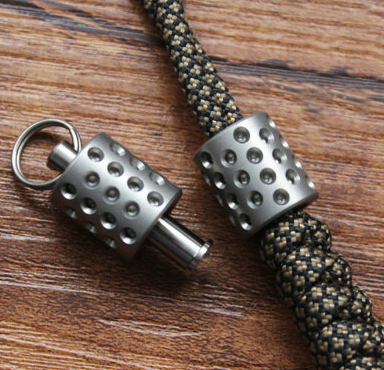

Zirconium beads for paracord sit at the top of the material hierarchy. They’re lighter than steel, tougher than titanium in some ways, and develop a unique surface character over time. But they cost more—sometimes significantly more. This guide breaks down what you’re actually paying for, when it makes sense, and how to choose wisely.
More about paracord beads:
What Exactly Are Zirconium Paracord Beads?
Zirconium beads are small, drilled components made from commercially pure zirconium metal (atomic number 40), designed to thread onto paracord for lanyards, knife fobs, bracelets, and EDC accessories. Unlike titanium or steel, zirconium naturally forms a dense oxide layer that creates distinctive color shifts—from bronze to blue-black—through heat treatment or wear.

Proper Bore Diameter and Machining Quality in Zirconium Paracord Beads
Zirconium is used in nuclear reactors and surgical implants due to its extreme corrosion resistance. For paracord work, this means a bead that won’t rust, won’t tarnish like brass, and develops character instead of degrading.
The Evolution of Paracord Hardware
- 10 years ago: Dominated by brass (tarnishes fast, stains skin) or stainless steel (heavy, surface rust in humidity).
- 2010–2012: Titanium emerged—lighter, corrosion-proof, but visually static (anodizing fades).
- Zirconium solved the core problem: it combines titanium’s corrosion resistance with a self-renewing surface that actually improves aesthetically with handling. The oxide layer is a permanent chemical transformation of the surface metal, not a coating.
Zirconium vs Titanium Beads: The Real Differences
| Material | Weight (per cm³) | Corrosion Resistance | Surface Character | Durability | Typical Cost |
| Brass | 8.5g | Poor (tarnishes) | Patina (green/brown) | Moderate | $ |
| Stainless Steel | 7.9g | Good | Static | Excellent | $ |
| Titanium | 4.5g | Excellent | Static (anodizing fades) | Excellent | $$ |
| Copper | 8.9g | Poor | Heavy patina | Moderate | $ |
| Zirconium | 6.5g | Excellent | Evolving oxide colors | Excellent | $$$ |
- Weight: Zirconium (6.5g) sits between the lightness of Titanium (4.5g) and the density of Steel (7.9g).
- Corrosion Resistance: Zirconium is virtually impervious to saltwater, sweat, and cleaning chemicals.
- Surface Character (The Separator): Titanium stays static. Zirconium changes with body oils, friction, or controlled heat, developing permanent, evolving colors (patina) that reform even after being scratched.
The Engineering Trade-Off: What You Sacrifice for Zirconium
- Higher Cost: Zirconium typically runs $20–40 per bead, compared to $8–12 for a comparable titanium bead.
- Limited Availability: Zirconium is harder to machine than titanium, resulting in fewer makers and potentially inconsistent tolerances (e.g., bore diameters).
- Tight Bore Issues: The dense oxide layer can make threading difficult with full 550 paracord if the bore is very snug. You may need to use a fid or slightly ream the hole.
Why Zirconium Beads for EDC Make Sense (And When They Don’t)

Zirconium Bead on Custom Knife Lanyard Showing Natural Patina Development
You should consider zirconium if:
- You’re building EDC gear exposed to harsh environments (marine, industrial, high-humidity).
- You want a bead that develops unique character through use (a “living surface”).
- You’re making a high-end custom piece where material quality signals craftsmanship.
- You are sensitive to metal allergies (zirconium is hypoallergenic).
- You value long-term durability over initial cost.
Skip zirconium if:
- You are new to paracord crafting or have a tight budget.
- You prefer a static, unchanging aesthetic.
- You are making gear for high-loss scenarios.
Think of it this way: zirconium is the premium, collector-grade material. The premium makes sense when the material choice is part of the experience, not just a functional component.
What to Look For When Buying Zirconium Beads
- Bore Diameter and Consistency: Standard 550 paracord (4 мм) requires a 4.5–5 мм bore. Ask the maker for exact measurements.
- Surface Finish: Look for smooth, even surfaces without “chatter marks.” The bore must be deburred (no sharp edges) to prevent fraying paracord.
- Heat Treatment vs. Anodizing: Quality zirconium is heat-colored (controlled oxidation) for permanent color. This is not a coating and will not wear off. Be wary of sellers incorrectly calling this “anodizing.”
- Weight Check: Real zirconium (6.5g/cm³) is noticeably denser than titanium (4.5g/cm³). If it feels as light as titanium, it may be mislabeled.
“Real zirconium is noticeably denser in hand—it has heft. If it feels as light as titanium, it probably is. Also, the heat-colored surface is not a coating; it’s the metal itself.”
Common Mistakes That Ruin Zirconium Beads
- Mistake 1: Forcing oversized paracord through a tight bore. The cost: Damages the interior, compromises the bead’s structure, and frays the paracord. Solution: Use the correct bore size (4.5–5 мм for 550 cord) or use a fid.
- Mistake 2: Using abrasive cleaners or polishing compounds. The cost: Strips away the unique, evolving oxide layer (the defining feature). Solution: Clean only with warm water and mild soap. To reset the surface, use controlled heat, not abrasives.
- Mistake 3: Mixing zirconium with dissimilar metals in wet environments. The cost: Causes galvanic corrosion of the less noble metal (like brass or steel) when exposed to saltwater or sweat. Solution: Pair zirconium only with titanium, stainless steel, or other corrosion-resistant metals.
How to Integrate Zirconium Beads Into Your Projects
- For Knife Lanyards: Position the bead closer to the handle, allowing body heat and oils to accelerate patina development.
- For Bracelets: Use odd numbers (3 or 5 beads) spaced evenly within a cobra weave or snake knot. Place zirconium at the center of the mixing materials.
- For Flashlight Fobs: A single bead at the tail cap adds ideal weight to prevent rolling without being cumbersome.
- For Zipper Pulls: Use small beads (8–10 мм) and consider gutted paracord (inner strands removed) for a cleaner look and easier threading.
The Strongest Argument Against Zirconium

Zirconium Paracord Beads with Natural Oxide Color Development
The counterpoint: Zirconium is overkill for most paracord applications. A $10 titanium bead will perform the utilitarian job perfectly without the maintenance or cost premium. The value of zirconium is entirely aesthetic—the evolving patina—which only matters to a specific, dedicated audience.
Conclusion: Zirconium is for the EDC enthusiast who views their gear as a long-term, custom collection. You are paying for a living surface that records your use and a high-end material that will last indefinitely. If this material nuance matters, the premium is justified.
Caring for Zirconium Paracord Beads Long-Term
- Maintenance: Almost none needed.
- To accelerate patina: Handle the bead frequently (body oils/heat). Alternatively, heat gently with a torch while rotating; stop when the color shifts from straw/bronze to blue/purple.
- To clean: Warm water and mild soap. Rinse well after saltwater exposure.
- To remove deep scratches: Sand with progressively finer grit (400 → 800 → 1200) and then re-heat treat to restore the oxide layer.
Three Things Most People Don’t Know
- Pyrophoric in Powder Form: Solid beads are safe, but fine zirconium dust or shavings ignite easily and burn intensely (hence the need for coolant during machining).
- Self-Limiting Oxide: The oxide layer is a dense barrier that stops further corrosion (unlike rust).
- Heat Memory: If you heat-color a bead and then scratch it, the newly reforming oxide layer will eventually return to approximately the original heat-treated color, as the metal “remembers” its thermal history.