


Titanium paracord beads combine aerospace-grade durability with minimal weight penalty for knife lanyards, EDC accessories, and outdoor gear customization.
More about paracord beads:
- All About Paracord Beads
- Paracord Beads: The Complete Guide to Choosing and Using Lanyard Hardware
- Practical Guide: How to Polish Titanium Beads
What Makes Titanium Beads for Paracord Different From Other Metals?
Titanium offers the highest strength-to-density ratio of any metallic element. It matches some steels in tensile strength but weighs 45% less.
For lanyard beads, this means your knife or keychain attachment won’t sag in your pocket. A 14mm titanium bead weighs roughly 11 grams. The same-sized brass bead hits 22 grams—exactly double.
The math is straightforward. Titanium density sits at 4.5 g/cm³. Stainless steel reaches 8 g/cm³. Same volume, half the mass.
Grade 5 titanium (Ti-6Al-4V) dominates the paracord bead market. This alloy contains 90% titanium, 6% aluminum, and 4% vanadium. The aluminum cuts weight further while vanadium adds durability. Aerospace manufacturers use this exact alloy for aircraft structural components where failure isn’t an option.
Tensile strength ranges from 895 to 1100 MPa. Your bead won’t deform when your knife hangs from a carabiner during a climbing fall.
From Fighter Jets to Your Keychain: How We Got Here
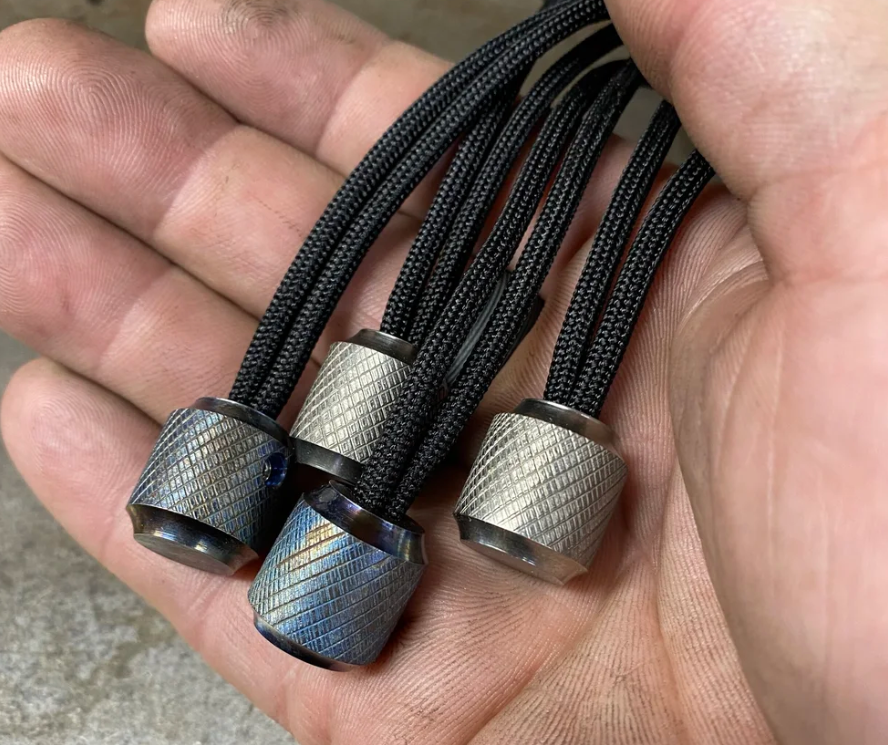
Titanium paracord beads enhancing the durability and style of outdoor DIY projects.
Twenty years ago, paracord users grabbed whatever worked—brass nuts from hardware stores, glass beads from craft shops, carved wood pieces.
Each material had fatal flaws. Brass oxidized and left green stains on fabric. Glass shattered on impact. Wood swelled when wet, jamming in place and fraying the cord.
The military had used titanium in fighter jets since the 1950s. Medical device manufacturers implanted titanium screws and plates in millions of patients. By 2010, CNC machining costs dropped low enough for small manufacturers to machine titanium beads for the EDC market.
Some makers tried aluminum alloys first. Too soft. They dented if you dropped your keys on concrete.
Others experimented with carbon fiber composites. The material looked futuristic but cracked when threaded or exposed to UV light over time.
Titanium solved what brass, aluminum, and carbon fiber couldn’t. Zero corrosion in any environment. Extreme durability without weight penalty. Precise CNC threading that won’t strip after hundreds of uses.
Why Choose Titanium Paracord Beads for Your EDC Gear?
- Weight stays minimal: An 11-gram bead versus a 22-gram brass alternative matters when you carry five pieces of gear on a keychain or assemble a multi-bead bracelet. Those 11 grams multiply. A survival bracelet with four beads saves 44 grams—the weight of a full Bic lighter. Less pocket sag. Less fatigue during all-day wear.
- Corrosion never starts: Titanium resists saltwater, chlorine, and even aqua regia (a mix of nitric and hydrochloric acid that dissolves gold). Your bead looks identical after a week-long coastal camping trip. No rust stains. No pitting. No maintenance required.
- Strength under load: Grade 5 titanium handles tensile loads up to 1100 MPa. Your lanyard bead won’t bend when your knife catches on a branch during a scramble up steep terrain.
- Skin contact causes zero reactions: Titanium is biologically inert. Surgeons implant it in human bodies permanently. If nickel allergies make brass or stainless steel jewelry irritating, titanium eliminates that problem completely.
- Temperature range is extreme: Titanium maintains structural integrity from -200°C to 430°C. Your bead won’t become brittle in winter camping conditions or soften near a campfire.
“Heavy lanyard beads slow down knife deployment by a full half-second in cold weather with gloves on. You’re fumbling for grip instead of getting instant purchase. A lightweight titanium bead sits exactly where you pinch—every single time.”
Common Uses for 550 Paracord and Titanium Beads
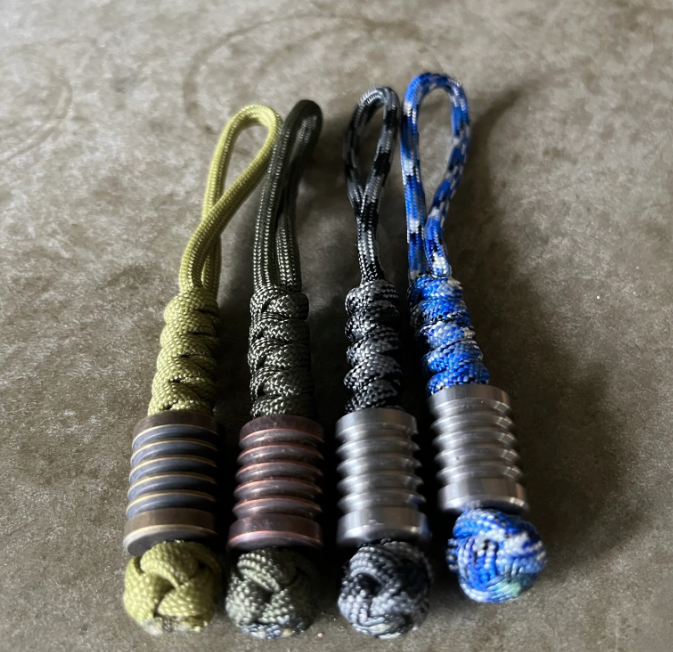
Why titanium beads are the best choice for paracord accessories.
- Knife lanyards: Thread a bead onto 550 paracord attached to your folding knife. The bead provides grip for quick extraction from a pocket and creates a visual marker so you can identify your knife in a gear bag. Most users prefer 11-14mm beads—large enough to grab with gloves but small enough to avoid excessive bulk.
- Zipper pulls: Replace weak zipper tabs on backpacks, jackets, and tents with cord and a bead. The added weight helps zippers track smoothly in both directions. The grip surface makes opening gear easier when your hands are wet or you’re wearing heavy gloves.
- Keychain organization: Use beads as spacers between individual keys or as decorative endpoints on cord key fobs. Titanium won’t scratch car paint like steel or corrode from daily handling like brass.
- Flashlight attachments: Factory flashlight lanyards break within months of daily use. A custom cord lanyard with a bead creates a permanent attachment that improves grip when you’re holding the light in your teeth or operating it with one hand.
- Bracelet closures: Survival bracelets need reliable fasteners that won’t open accidentally. A bead with the correct bore diameter creates a secure closure you can remove quickly when you need to deploy the cord for emergency use.
Under the Microscope: Material Science Details
Titanium’s crystal structure explains its unusual properties. At room temperature, it forms a hexagonal close-packed (HCP) lattice. This structure resists deformation better than the body-centered cubic (BCC) structure found in many steels.
The material forms a passive oxide layer—TiO₂—within milliseconds of air exposure. This layer is only 1-2 nanometers thick but completely blocks further oxidation. Scratch the surface and a new oxide layer forms immediately. This self-healing property explains why titanium never rusts.
Grade 5 titanium’s 6% aluminum content reduces density while the 4% vanadium stabilizes the beta phase at room temperature. The result is a two-phase microstructure (alpha + beta) that combines the corrosion resistance of pure titanium with significantly higher strength.
Thermal conductivity sits at just 7.4 W/m·K—roughly 1/25th that of aluminum. Your bead won’t conduct heat from a campfire to the cord attachment point. The cord stays safe even when the bead gets warm to the touch.
Coefficient of thermal expansion is 8.6 × 10⁻⁶ /°C. For practical purposes, your bead’s bore diameter won’t change enough to matter across the temperature range you’ll encounter outdoors. A 5mm bore at 20°C expands to approximately 5.0004mm at 100°C—completely negligible.
The Bronze vs. Titanium Decision for Lanyard Beads
Bronze beads weigh approximately twice as much as titanium. That density creates momentum when you swing the lanyard to extract a knife from your pocket.
The extra mass helps your fingers locate the loop instantly. For pocket knives in particular, a heavier bead stabilizes the lanyard tail, making extraction more predictable.
But that weight creates costs. Heavier beads swing more forcefully, potentially scuffing knife scales or scratching other items in your pack. They create visible “pocket print”—the outline of items showing through fabric. Bronze develops patina over time, which some users love for its character but others find messy when it transfers to clothing or skin.
Titanium requires zero maintenance. No tarnishing. No polishing. Just soap and water when needed. For users who rotate between saltwater fishing, freshwater camping, and dusty trail environments, that stability outweighs aesthetic character.
Choose bronze when you value tactile feedback and traditional aesthetics. Choose titanium when you need set-it-and-forget-it performance with minimal weight.
How to Pick the Right Titanium Beads for Paracord Projects

DIY paracord creations featuring durable titanium beads.
- Bore diameter matters most: Standard 550 paracord measures 4mm in diameter. Most beads designed for paracord have bore diameters between 5mm and 5.5mm. That 1-1.5mm clearance allows easy threading while keeping the bead positioned where you want it. Double-check measurements if you’re using thicker cord variants or planning to double up cord for added strength.
- Outer diameter affects function: Smaller beads at 10-12mm work well for minimalist setups or bracelets where bulk matters. Larger beads at 14-18mm provide better grip for knife lanyards and flashlight attachments, especially when wearing gloves.
- Length changes purpose: Shorter beads at 4-6mm function primarily as decorative spacers. Longer beads at 10-15mm offer more surface area for grip and can be laser-engraved with custom designs or emergency contact information.
- Surface finish impacts grip: Polished titanium feels smooth and resists dirt accumulation but can be slippery when wet. Bead-blasted or textured finishes provide better grip at the cost of slightly faster wear from pocket abrasion.
- Anodized colors are permanent: Titanium can be anodized to create blues, purples, and golds through controlled oxide layer growth. These colors won’t rub off like paint. They can be scratched to reveal bare metal underneath, but the color itself is part of the metal’s surface structure.
Three Mistakes That Ruin Your Gear
Mistake 1: Threading new cord through undersized bores
You buy a bead listed as “5mm bore for 550 paracord.” The cord won’t thread through. You assume the bead is defective.
People do this because listings don’t always specify whether the bore measurement accounts for cord compression. Standard 550 paracord has seven inner strands that compress when forced through tight openings.
Standard 550 paracord has an outer diameter of approximately 4mm, but you need at least a 5.5mm bore for smooth threading. Forcing cord through a 5mm bore frays the outer sheath, weakening the cord’s strength rating. Your paracord rated for 550 pounds might now fail at 300 pounds. You’ve compromised emergency functionality and wasted time wrestling with an incompatible fit.
Mistake 2: Using beads as hammering tools or pry points
You’re camping and use your bead to tap tent stakes into hard ground or pry open a stuck clasp on your pack.
People do this because titanium’s aerospace reputation creates an assumption it’s indestructible for any task. The smooth, dense surface looks tough enough to handle impact work.
Titanium has excellent tensile strength but lower hardness than heat-treated steel. Using a bead for impact tasks creates permanent deformation—flat spots that ruin smooth threading and catch on fabric. More seriously, you transfer impact force directly to the cord knot, potentially loosening connections or causing hidden damage to cord fibers. Your bead loses functionality and the attachment becomes a weak point when you actually need it.
Mistake 3: Mixing titanium with dissimilar metals on the same lanyard
You create a custom knife lanyard with a titanium bead, brass washer, and stainless steel snap hook because you like the mixed-metal aesthetic.
People do this because different metals create visual contrast. The design looks custom and unique.
When dissimilar metals touch in the presence of an electrolyte (sweat, rain, seawater), galvanic corrosion accelerates. The less noble metal corrodes faster while the more noble metal stays protected. In a titanium-brass pairing, the brass corrodes aggressively. Green-brown staining spreads to your cord and transfers to fabric and skin. In humid or coastal environments, you might see visible corrosion within weeks rather than years. Your aesthetic lanyard becomes an oxidized mess that ruins pockets, stains clothing, and may eventually fail at the corroded connection point. You lose 70-80% of the brass component’s service life and need to disassemble and rebuild the entire lanyard.
“New students over-tighten their bead knots, thinking tighter means more secure. Wrong. The cord needs to move slightly when loaded or it concentrates stress on individual fibers. Leave just enough slack that the bead can shift a millimeter when pulled hard—that flex distributes force and prevents premature cord failure.”
Field Test Data: What Actually Happens

Expert tips on how to choose the best titanium paracord beads for your projects.
Test 1: Six-month wilderness program
A bushcraft instructor attached titanium paracord beads to 20 student knives used daily in outdoor skills training. The knives were deployed multiple times per day, dropped on rocks, dragged through mud, submerged in streams, and exposed to campfire smoke.
Zero bead failures occurred. Three beads showed minor scratches on anodized surfaces where they’d been dragged across granite. The base metal remained intact. All bore diameters retained their original dimensions—no threading wear developed. Cord around the beads showed normal wear from use but no accelerated fraying from bead edges.
Test 2: Simulated pocket extraction cycles
A gear testing lab compared titanium, brass, aluminum, and stainless steel beads by subjecting them to 10,000 cycles of simulated pocket extraction. Each cycle involved sliding the bead against 600-grit sandpaper to mimic fabric abrasion.
Results showed beads lost an average of 0.3 grams of mass. Aluminum beads lost 1.8 grams and developed visible grooves. Brass beads lost 0.7 grams and showed surface pitting. Stainless steel performed similarly at 0.4 grams lost but weighed twice as much initially.
Titanium vs. Other Materials: Direct Comparison
| Material | Weight (14mm bead) | Corrosion Resistance | Strength (Tensile) | Cost | Maintenance | Skin Safety |
| Grade 5 Titanium | ~11g | Excellent | 895-1100 MPa | $$ | Minimal | Hypoallergenic |
| Brass (C932) | ~22g | Fair (tarnishes) | 380-450 MPa | $ | Moderate | Can stain skin |
| Stainless Steel (316) | ~24g | Good | 515-620 MPa | $ | Low | Generally safe |
| Aluminum (6061-T6) | ~8g | Moderate | 310 MPa | $ | Moderate | Generally safe |
| Bronze (unleaded) | ~23g | Fair (patinas) | 400-550 MPa | $ | High | Can stain skin |
The data shows titanium’s advantage clearly. Only aluminum weighs less, but aluminum’s strength is roughly one-third of Grade 5 titanium. For the same strength requirements, you’d need a physically larger aluminum bead, which negates the weight advantage.
Advanced Techniques for EDC and Survival Applications
These methods require more skill but expand what beads can do:
- Double-bead indexing system: Thread two beads of different sizes or finishes onto your knife lanyard. Position them so you can identify which side of the knife is up by touch alone. This works in darkness or when wearing gloves.
- Emergency whistle conversion: Some manufacturers machine beads with internal chambers that function as survival whistles. The sound frequency sits around 120 decibels—audible up to a mile in open terrain.
- Fire starter integration: Combine a bead with a ferrocerium rod insert. Scrape the rod with the back of a knife blade to generate sparks for fire starting. Titanium won’t conduct heat, protecting the cord attachment point.
- Modular bead systems: Use multiple small beads with standardized threading to create customizable lanyard configurations. Swap beads based on activity—add a compass bead for hiking, switch to a glow-in-the-dark tritium vial holder for night operations.
The Strongest Argument Against Titanium
Cost stops many buyers. A quality titanium bead runs $15-40. The equivalent brass or stainless steel bead costs $3-8.
For someone building their first lanyard or bracelet, that price difference matters. You’re learning threading techniques and knot patterns. Mistakes happen. Damaging a $5 brass bead during learning feels different than ruining a $30 piece.
Budget-conscious users should start with stainless steel or brass. Learn the techniques. Make your mistakes on cheaper materials. Once you’ve mastered the basics and know exactly what you want, invest in titanium for your primary EDC gear.
The counterargument: titanium’s durability means you buy it once. Brass beads need replacement after developing patina stains or corrosion. Aluminum beads dent and lose functionality. Over five years of daily use, titanium’s higher upfront cost becomes the cheaper option per year of service.
The decision depends on your time horizon. Building temporary learning projects? Brass works fine. Creating permanent EDC gear you’ll use daily for years? Titanium pays off.
Making Your Decision
Titanium paracord beads excel when your priorities align with the material’s strengths. You want minimum weight without compromising strength. You need zero maintenance across varied environments. You require hypoallergenic properties for extended skin contact.
The material’s aerospace origins transfer directly to outdoor reliability. Your bead won’t rust during a week-long kayaking trip. It won’t crack when temperatures drop below freezing. It won’t cause allergic reactions during hot-weather hiking.
Start with a single bead on your most-used gear—the knife you carry daily or the flashlight in your pocket. Run it through your normal routine for a month. The differences from conventional materials become clear through daily use rather than specification comparisons.
Quality matters more than price point. A poorly machined bead with sharp bore edges defeats the material’s advantages by fraying cord. Look for beads with chamfered edges, consistent bore diameters, and smooth finishes. These details indicate precision manufacturing that translates to reliable long-term performance.